
Neuro Salt Review 2026: Does It Actually Work?

Neuro Salt looks most promising when (and only when) it’s truly delivering clinically relevant doses of its core neuropathy nutrients like alpha-lipoic acid (ALA), benfotiamine, and methylcobalamin (B12). The calming herbs may help some people sleep through symptoms, but they are not the same thing as nerve repair.
Set expectations: Neuro Salt is a support supplement for nerve discomfort (tingling, burning, irritability at night). It’s not a treatment or cure for peripheral neuropathy, and it won’t replace a proper workup for underlying causes.
Quick scorecard (what this review covers):
- Ingredients: Are they evidence-based for neuropathy?
- Dosage: Are amounts likely effective, or “label decoration”?
- Safety: Side effects and interactions (especially sedating herbs + B6).
- Transparency: Supplement Facts, standardized extracts, COA/third-party testing.
- Real users: What people report vs what’s plausible.
- Alternatives: Nutrient stacks, topicals, prescriptions, and lifestyle fixes.
Medical disclaimer: Neuropathy has many causes (diabetes/prediabetes, B12 deficiency, thyroid disease, alcohol use, medications/chemotherapy, nerve compression, autoimmune issues). If symptoms are new, worsening, one-sided, or affecting strength/balance, talk to a clinician promptly.
Who Neuro Salt Is For (and Who Should Skip It)
Neuro Salt is likely a fit if you:
- Have mild-to-moderate tingling/burning and want a non-prescription option to try first.
- Prefer a plant-based formula that also targets stress, tension, and sleep.
- Want an “all-in-one” supplement instead of buying ALA + benfotiamine + B12 separately (as long as doses are truly disclosed and adequate).
Consider skipping (or only using with medical guidance) if you:
- Are pregnant or breastfeeding (most herbal blends are “avoid” here due to limited safety data).
- Take sedatives, opioids, benzodiazepines, sleep meds, or drink alcohol regularly (due to additive drowsiness risk with calming botanicals).
- Have liver disease, complex medical conditions, or an upcoming surgery (herbs and antioxidants can complicate anesthesia plans or perioperative meds).
- Have known allergies/sensitivities to botanical compounds.
Red flags that need medical evaluation (not a supplement trial):
- Sudden numbness/weakness, facial droop, or one-sided symptoms
- New loss of balance or repeated falls
- Foot ulcers, skin color changes, or infections (especially in diabetes)
- New bowel/bladder changes, saddle numbness, or severe back pain
What outcomes are realistic
- Realistic: less intense tingling/burning, improved sleep, calmer nervous system response, fewer nighttime flare-ups.
- Not realistic: guaranteed “nerve regeneration” or “complete repair” without identifying and treating the underlying cause.
Neuro Salt
Your Trusted Nerve Health Supplement
What Neuro Salt Claims to Do (and How It’s Supposed to Work)
Most Neuro Salt-style marketing claims fall into a few buckets:
Common claims you’ll see:
- Reduce nerve pain, tingling, burning, hypersensitivity
- Support nerve endings and “nerve repair”
- Calm nerve inflammation and oxidative stress
- Improve microcirculation and nerve signaling
- Promote relaxation and sleep so symptoms feel less intrusive
Mechanism buckets that actually matter (and we’ll evaluate later):
- Antioxidant support (oxidative stress is implicated in diabetic neuropathy)
- Inflammation modulation
- Nerve metabolism + microcirculation support
- Myelin/nerve nutrient support (B vitamins, especially B12 in deficiency states)
- Sedative/analgesic botanicals that change symptom perception (often strongest for “night symptoms”)
What determines credibility:
- A complete Supplement Facts panel with exact dosages
- Standardized extracts for key botanicals (not just “powder”)
- Bioavailable forms (for example methylcobalamin for B12)
- Clear third-party testing and a COA (certificate of analysis) per batch
Ingredients Breakdown: What’s Inside Neuro Salt (Evidence-Based)
Below is an evidence-focused way to look at the ingredients mentioned across Neuro Salt descriptions and typical neuropathy formulas. If your bottle label differs, use this as a framework and judge your exact Supplement Facts.
Ingredient (evidence-based overview)
Alpha-lipoic acid (ALA)
- Antioxidant; may reduce neuropathic symptoms (esp. diabetic)
- Moderate (human data, mainly diabetic neuropathy)
- Often 600 mg/day (varies by study/form)
- GI upset; may lower glucose, caution with diabetes meds
Benfotiamine
- Supports thiamine-dependent pathways, may help diabetic neuropathy symptoms
- Moderate (human data, mostly diabetic neuropathy)
- Commonly 300–600 mg/day
- Generally well-tolerated; check label dose
Methylcobalamin(B12)
- Myelin + nerve function support; essential in deficiency
- Strong in deficiency; mixed for idiopathic neuropathy
- Often 1,000–2,000 mcg/day used in trials/clinical practice
- Usually safe; confirm deficiency with labs if possible
Acetyl-L-carnitine (ALCAR)
- Nerve pain support; mitochondrial support
- Moderate (some human evidence)
- Often 1,000–2,000 mg/day
- Nausea/diarrhea; “fishy” odor; agitation in some
Vitamin B6 (P-5-P)
- Nerve metabolism; deficiency support
- Conditional; toxicity risk
- Keep total daily intake conservative (often ≤10–25 mg/day unless supervised)
- Too much B6 can cause neuropathy-like symptoms
Evening primrose oil (GLA)
- Fatty acid support; possibly helps nerve symptoms
- Varies; GLA content matters
- GI upset; caution with anticoagulants
Passionflower
- Calming/sleep; may reduce symptom distress at night
- Indirect/supportive
- Drowsiness; interactions with CNS depressants
California poppy
- Traditional sleep/pain herb
- Limited neuropathy-specific evidence
- Drowsiness; avoid with sedatives/alcohol
Corydalis
- Analgesic signals in research
- Limited to moderate, quality dependent
- Interaction potential; quality/standardization important
Marshmallow root
- Soothing mucilage; GI/throat support
- Low for neuropathy
- May reduce absorption of meds if taken together
Prickly pear
- Antioxidant/anti-inflammatory plausibility
- Generally safe; GI upset possible
If Neuro Salt uses a proprietary blend or hides doses: that blocks a real dosage assessment and should lower confidence. For neuropathy support, dose is often the difference between “might help” and “won’t move the needle.”
Botanical Ingredients (Symptom Calming vs True Nerve Repair)
Passionflower (Passiflora incarnata)
Passionflower is best known for anxiety and sleep support, which can indirectly help neuropathy by reducing the “wired, overstimulated” feeling that makes nighttime tingling or burning feel worse. The tradeoff is that it can cause drowsiness, especially when combined with alcohol or sedating medications.
California poppy (Eschscholzia californica)
California poppy has traditional use for sleep and mild pain. The neuropathy-specific evidence is limited, but in real life, better sleep can improve perceived symptom severity. Main caution: CNS depression (feeling overly sedated), especially if stacked with other calming herbs or medications.
Corydalis (Corydalis yanhusuo)
Corydalis is one of the more “pain-relevant” botanicals in this type of formula, with research interest in analgesic compounds. The big issue is quality and standardization. “Corydalis powder” is not the same as a standardized extract with known active content. It also may have drug interaction concerns depending on what you take.
Marshmallow root (Althaea officinalis)
Marshmallow root is mainly a mucilage, soothing herb. It can be useful for GI comfort, but it is unlikely to be a primary driver of neuropathy improvement. Practical caution: mucilage herbs can interfere with absorption of medications and supplements if taken at the same time.
Prickly pear (Opuntia spp.)
Prickly pear has plausible antioxidant and anti-inflammatory benefits, but there’s a gap between general antioxidant potential and measurable improvement in neuropathy symptoms. Think of it as a supportive add-on, not a cornerstone.
Nerve-Support Nutrients Often Used in Neuropathy (What the Research Suggests)
Alpha-lipoic acid (ALA)
ALA is one of the most studied supplements for diabetic peripheral neuropathy, commonly at 600 mg/day in clinical contexts. People often notice effects as reduced burning/tingling rather than “full numbness reversal.” Bioavailability and timing can matter, and GI upset is a common limiting factor.
Key point: if Neuro Salt contains ALA but at a low dose, it may not replicate studied outcomes.
Benfotiamine
Benfotiamine is a fat-soluble thiamine derivative studied mostly in metabolic contexts (diabetes). In plain English, it supports pathways that can get stressed by high glucose and oxidative damage. Several studies suggest symptom support in diabetic neuropathy, typically using hundreds of milligrams per day.
Acetyl-L-carnitine (ALCAR)
ALCAR has evidence for neuropathic pain in some settings and is also used for nerve support, but doses are typically 1–2 grams/day, which many blended supplements do not provide. GI side effects can occur.
Vitamin B6 (as P-5-P)
B6 is tricky. You need it for nerve function, but chronic high intake can cause B6-induced neuropathy, which can mimic what you’re trying to treat. This is one of the biggest “hidden risks” when people stack multiple nerve supplements plus multivitamins.
Evening primrose oil (GLA)
GLA has mixed evidence. Some people report improvements in nerve symptoms, but it’s usually best viewed as an add-on rather than your primary intervention.
Dosage Assessment: Are the Amounts in Neuro Salt Likely Effective?
Dose matters because many supplements include “good ingredients” at amounts too small to do much.
Step 1: Check the Supplement Facts (writer insert)
Insert the exact label here (per 2 capsules/day), including mg/mcg amounts for:
- Alpha-lipoic acid (ALA)
- Benfotiamine
- Methylcobalamin (B12)
- Vitamin B6 (P-5-P)
- Any added nutrients (ALCAR, GLA)
- Amounts and forms of botanicals (extract vs powder; standardization info)
Step 2: Compare to commonly studied ranges
As a rough benchmark (not medical advice):
- ALA: often 600 mg/day in diabetic neuropathy research
- Benfotiamine: commonly 300–600 mg/day
- B12 (methylcobalamin): often 1,000–2,000 mcg/day, especially when deficiency is possible
- ALCAR: often 1,000–2,000 mg/day
- B6: keep conservative; avoid piling on high total daily intake
Step 3: Proprietary blends reduce confidence
If Neuro Salt lists a proprietary blend for key ingredients, you cannot verify whether it’s under-dosed. In 2026, there’s little reason to accept dose secrecy in a nerve supplement, because the “heavy hitters” are not exotic.
Step 4: Capsule count feasibility
Neuro Salt is commonly positioned as 2 capsules/day. That’s convenient, but it also limits how much ALA or ALCAR can realistically fit. If the label claims “therapeutic dosing,” check whether the math actually works.
Bioavailability notes
- Methylcobalamin is a well-recognized active form of B12.
- With ALA, form and timing can affect tolerance. Some do better with meals (less GI upset), though absorption dynamics vary.
- Botanicals: extracts with standardization are more credible than vague “powders.”
Safety + Side Effects: What to Watch For (With Evidence)
Common side effects (most reported)
- GI upset: nausea, reflux, diarrhea (often from ALA and/or ALCAR)
- Drowsiness / sedation: passionflower, California poppy, corydalis (especially when combined)
- Dizziness or headache: can happen with many supplements, especially during the first week
More serious risks and interactions
- CNS depressants + alcohol: additive sedation. Avoid mixing Neuro Salt with alcohol or sedative meds unless your clinician approves. Avoid driving if you feel impaired.
- Surgery/anesthesia: stop herb-heavy supplements ahead of surgery per your surgeon’s instructions.
- Diabetes medications: ALA may improve insulin sensitivity and lower glucose in some people, so monitor for hypoglycemia if you take glucose-lowering meds.
- Vitamin B6 toxicity risk: too much B6 over time can worsen neuropathy-like symptoms. Check totals from multivitamins, energy drinks, and other “nerve support” stacks.
How to trial safely (practical approach)
- Start with the lowest effective amount allowed by the label (some people start with 1 capsule to assess tolerance).
- Change one thing at a time for 2–4 weeks.
- Track: pain, burning, tingling, numbness, sleep quality, and next-day drowsiness.
- Stop if you have worsening symptoms, allergic reactions, severe sedation, or blood sugar issues.
Quality, Legitimacy, and Transparency Checks (2026 Buyer Checklist)
Here’s what I would personally check before paying full price for a neuropathy supplement.
Manufacturing basics
Look for:
- GMP manufacturing (Good Manufacturing Practices)
- Clear labeling: non-GMO, gluten-free, vegan capsules (if important to you)
- A real company identity: address, phone/email support, and a consistent brand presence
Third-party testing (the big one)
Ideally, Neuro Salt provides:
- A COA per batch (identity, potency, heavy metals, microbes)
- Clear testing scope for botanicals (botanicals are more prone to adulteration variability)
Regulatory reality
The FDA does not approve dietary supplements the way it approves drugs. Compliant brands avoid “treat/cure” language and provide clear supplement labeling.
If a site claims “FDA approved supplement,” treat that as a red flag phrasing and look for the more accurate language: FDA-registered facility and GMP.
Reputation signals (how to interpret them)
- Trustpilot/BBB/Reddit can be useful for spotting patterns (shipping issues, refund friction, side effects), but don’t treat star ratings as clinical evidence.
- Be cautious with “review sites” that are clearly affiliate pages repeating the sales copy.
Counterfeit avoidance
- Buy from the official website when possible.
- Avoid random marketplace listings with no lot numbers or return support.
- Look for tamper seals, lot number, and a clear return policy.
Real User Experience (What People Report vs What’s Plausible)
When I evaluate user reports, I’m looking for patterns that match what the ingredients realistically do.
What I looked for
- Repeated themes across different platforms (not just one affiliate page)
- Time-to-effect: same-day vs 4–8 weeks
- Whether users mention condition type (diabetic neuropathy, idiopathic, chemo-induced)
- Whether they changed other variables (glucose control, B12 injections, new shoes, stopping alcohol)
Common positives people report
- Better sleep quality
- Reduced nighttime tingling and less “burning”
- Feeling calmer, less keyed up in the evening
Plausible explanation: these improvements align strongly with calming botanicals and possibly with ALA/B vitamin support if dosed adequately.
Common negatives people report
- “No change” (very common in neuropathy supplements)
- Drowsiness or grogginess
- Stomach heaviness or nausea
- Inconsistent results week to week
Why mixed outcomes happen: neuropathy is not one condition. If your root cause is uncontrolled glucose, B12 deficiency, alcohol, a medication side effect, or nerve compression, a supplement may do little until that’s addressed.
How long it may take
- Calming herbs: potentially same day to 1 week
- Nutrient-based nerve support: often 4–8 weeks (sometimes longer), and results can be subtle
A simple credibility filter for testimonials
Trust reviews more when they include:
- Exact symptom type and severity
- Timeline (“week 2,” “week 6,” etc.)
- Dose used and whether they stopped other supplements Be skeptical when reviews sound like marketing copy or promise “total cure.”
Neuro Salt Price, Packages, and Money-Back Guarantee (Is It Worth It?)
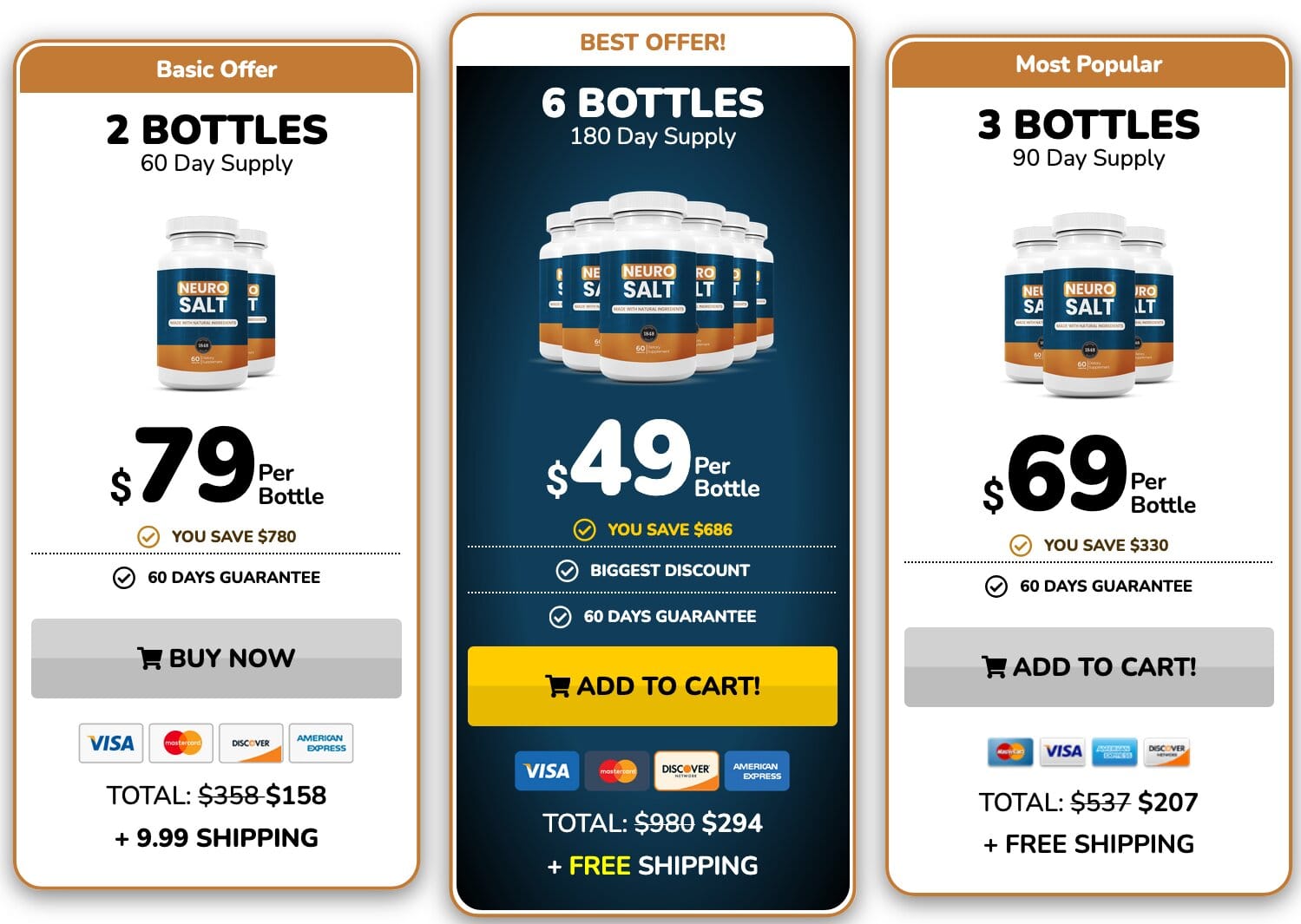
Based on the info provided, Neuro Salt is commonly priced around $49 per bottle (60 capsules), with a suggested dose of 2 capsules/day (so roughly a 30-day supply).
Value framework (how I'd judge it)
If Neuro Salt truly contains clinically relevant doses of ALA, benfotiamine, and methylcobalamin, $49/month can be fair for the convenience. However, if dosages are low or hidden in a proprietary blend, it may be cheaper and more effective to buy each ingredient separately at studied doses and skip the "mystery blend" markup.
Money-back guarantee checklist
Neuro Salt is often advertised with a 60-day money-back guarantee. Before ordering, confirm the following:
- Is it 60 days from order date or delivery date?
- Are open bottles allowed?
- Are there any restocking fees?
- Who pays return shipping?
- How to contact support (example provided: [email protected])
Scam and pressure tactics to avoid
When purchasing health products like Neuro Salt, it's crucial to be aware of certain scam and pressure tactics that are often employed. These include:
- Countdown timers that reset
- "Only 7 bottles left" claims without any inventory transparency
- No real contact information, unclear refund steps, or aggressive upsells at checkout
Comparison: Neuro Salt vs Other Neuropathy Options (Supplements + Meds + Lifestyle)
Neuro Salt vs a targeted nutrient stack (ALA + benfotiamine + methylcobalamin)
A DIY stack often wins on clear dosing, easier comparison to clinical studies, and a lower cost per clinically relevant dose. Neuro Salt may have the edge on convenience, and its added calming herbs can be helpful if poor sleep is your main complaint.
Neuro Salt vs prescription neuropathic pain meds
Common prescriptions include gabapentinoids, SNRIs, and TCAs. They often have stronger symptom effects for moderate-to-severe pain, but can carry side effects (sedation, dizziness, weight changes, sexual side effects, withdrawal considerations).
Supplements can be adjuncts, but don’t replace clinical care when pain is severe or function is affected.
Neuro Salt vs topical options (lidocaine/capsaicin)
Topicals can provide faster localized relief, especially for burning feet, but they don’t address systemic contributors like glucose control or nutrient deficiency.
Neuro Salt vs lifestyle + medical workup (often the real “best option”)
If you only do one thing, do this:
- Check A1c/glucose, B12, thyroid labs if appropriate
- Review meds that can cause neuropathy
- Address alcohol intake
- Foot care, footwear, strength/balance work, physical therapy as needed
Root-cause work often outperforms any supplement.
Best-combo approach (for many people)
- Address the cause (glucose control, deficiency correction, med review)
- Add evidence-based nutrients if appropriate
- Use calming support at night only if sleep is being wrecked
How to Use Neuro Salt (Dosage, Timing, and Best Practices)
Neuro Salt’s exact label directions here. The common recommendation provided is:
- 2 capsules daily
Practical timing (based on how these ingredients behave)
- If Neuro Salt makes you sleepy, take it in the evening.
- If it upsets your stomach, take it with food (unless the label specifies otherwise).
Separate marshmallow root from meds
If marshmallow root is included, consider separating Neuro Salt from other medications/supplements by 2+ hours, because mucilage herbs can interfere with absorption for some people.
Tracking plan (simple and effective)
Before you start, rate each from 0–10:
- Burning
- Tingling
- Numbness
- Sleep quality Re-check at day 14 and day 28. If nothing changes by 4–8 weeks and doses are adequate, it may not be worth continuing.
When to stop or seek help
- Worsening numbness or new weakness
- Allergic reaction (hives, swelling, trouble breathing)
- Excess sedation or impaired driving
- Blood sugar lows if you’re on diabetes meds
What not to combine casually
- Alcohol + sedating herbs
- Multiple sedative botanicals stacked together
- High-dose B6 products layered on top of each other
FAQ-Frequently Asked Questions
Is Neuro Salt a cure for peripheral neuropathy?
No. It may help support symptoms and nerve nutrition, but it is not a cure and should not delay evaluation for treatable causes (like B12 deficiency or diabetes).
How long does Neuro Salt take to work?
If the calming herbs help you, you might notice sleep-related improvements within days. Nutrient-based changes often take 4–8 weeks (sometimes longer), and results can be subtle.
Can I take Neuro Salt with gabapentin (or other nerve pain meds)?
Possibly, but ask your clinician or pharmacist. The main concern is additive drowsiness if Neuro Salt includes sedating botanicals.
Does Neuro Salt help numbness?
Numbness, a common symptom of peripheral neuropathy, is often harder to shift than burning or tingling sensations, especially if the neuropathy is advanced. If numbness is progressing, it's crucial to prioritize a medical workup.
What’s the biggest safety issue to watch?
In practice: sedation interactions (herbs + alcohol/meds) and excess vitamin B6 from stacking multiple supplements.
Final Take: Should You Try Neuro Salt in 2026?
Neuro Salt is worth considering in 2026 if you can verify three things: transparent dosing, quality testing (COA), and a formula that matches your goal (symptom support, especially at night). If dosing is hidden or low, you’ll usually do better with standalone ALA + benfotiamine + methylcobalamin at clearly labeled amounts.
Pros
- Convenient “one product” approach
- Calming herbs may improve sleep and reduce nighttime symptom distress
- Includes neuropathy-relevant nutrients (in many versions of the formula)
Cons
- If doses are unclear or under-dosed, effectiveness drops fast
- Botanicals have limited neuropathy-specific evidence and can cause drowsiness
- Interaction risk for people on sedatives, alcohol, or complex medication regimens
Decision tree
- Rule out common causes (glucose/A1c, B12, thyroid, meds, alcohol).
- Choose a product with transparent dosing and testing.
- Trial for 30 days with tracking (continue to 8 weeks if you’re seeing improvement).
- Re-evaluate honestly. If it’s not helping, stop and pivot.
If you’re dealing with worsening symptoms or functional issues related to neuropathy, the safest move is a clinician-guided plan. Supplements like Neuro Salt can help around the edges, but root-cause treatment is where most of the meaningful progress comes from.
References (PubMed / Clinical Evidence to Cite)
- Ziegler, 2006 — Treatment of symptomatic diabetic polyneuropathy with the antioxidant alpha-lipoic acid: a meta-analysis — Diabetes Care (PubMed) https://pubmed.ncbi.nlm.nih.gov/16936145/
- Mijnhout et al., 2012 — Alpha lipoic acid for symptomatic peripheral neuropathy in patients with diabetes: a meta-analysis — International Journal of Endocrinology (PubMed) https://pubmed.ncbi.nlm.nih.gov/23056033/
- Haupt et al., 2005 — Benfotiamine in the treatment of diabetic polyneuropathy: a three-week randomized, controlled pilot study (BEDIP study) — International Journal of Clinical Pharmacology and Therapeutics (PubMed) https://pubmed.ncbi.nlm.nih.gov/15918164/
- Stracke et al., 1996 — Benfotiamine in diabetic polyneuropathy (randomized study) — Experimental and Clinical Endocrinology & Diabetes (PubMed) https://pubmed.ncbi.nlm.nih.gov/8891165/
- Sun et al., 2016 — Methylcobalamin: a potential vitamin of pain killer — Neural Plasticity (PubMed) https://pubmed.ncbi.nlm.nih.gov/27721840/
- Li et al., 2013 — Methylcobalamin treatment for peripheral neuropathy: a systematic review and meta-analysis — (Journal varies by indexing; PubMed record) https://pubmed.ncbi.nlm.nih.gov/23711268/
- Sima et al., 2005 — Acetyl-L-carnitine improves pain, nerve regeneration and vibratory perception in patients with chronic diabetic neuropathy — Diabetes Care (PubMed) https://pubmed.ncbi.nlm.nih.gov/16249544/
- De Grandis & Minardi, 2002 — Acetyl-L-carnitine in the treatment of diabetic neuropathy: an open study — (PubMed record) https://pubmed.ncbi.nlm.nih.gov/12048333/
- Parry & Bredesen, 1985 — Sensory neuropathy with low-dose pyridoxine (vitamin B6) — Neurology (PubMed) https://pubmed.ncbi.nlm.nih.gov/2417576/
- Vrolijk et al., 2021 — Vitamin B6 toxicity: exploring the mechanisms of pyridoxine-induced neuropathy — Advances in Nutrition (PubMed) https://pubmed.ncbi.nlm.nih.gov/34276006/
- Keen et al., 1993 — Treatment of diabetic neuropathy with gamma-linolenic acid — Diabetic Medicine (PubMed) https://pubmed.ncbi.nlm.nih.gov/8508623/
- Akhondzadeh et al., 2001 — Passionflower in the treatment of generalized anxiety: a randomized controlled trial — Journal of Clinical Pharmacy and Therapeutics (PubMed) https://pubmed.ncbi.nlm.nih.gov/11679026/
- FDA (official resource) — Dietary Supplements — U.S. Food & Drug Administration (Non-PubMed, clearly labeled) https://www.fda.gov/food/dietary-supplements
- NIH Office of Dietary Supplements — Dietary Supplement Label Database / Supplement guidance — (Non-PubMed, clearly labeled) https://ods.od.nih.gov/
Note: For botanicals like California poppy and corydalis, the evidence base is less neuropathy-specific and more focused on sleep/analgesia signals, and quality depends heavily on extract standardization and testing. If you want, paste Neuro Salt’s exact Supplement Facts panel and I’ll do a precise dose-by-dose comparison against studied ranges.
 Ellie Kinsey
About the author: Dr. Jane F. Crowford